Is ChatGPT Worth It? Full Review for Businesses
Artificial intelligence is no longer optional for businesses in 2026. One of the most popular tools leading this shift is ChatGPT. From startups to large companies, businesses are using it to automate tasks, create content, and improve productivity.
But the real question is simple. Is ChatGPT actually worth it for businesses, or is it just hype?
This detailed review will help you understand the real value of ChatGPT, its benefits, limitations, and whether it is the right choice for your business.
What is ChatGPT for business
ChatGPT is an AI powered tool that helps businesses generate content, answer questions, analyze data, and automate repetitive tasks. It works using advanced language models that understand and respond like a human.
Businesses use ChatGPT in many areas such as marketing, customer support, operations, and research. Today, it is considered one of the most versatile AI tools available.
In fact, millions of companies are already using it to improve efficiency and reduce costs.
Why businesses are using ChatGPT
The main reason businesses adopt ChatGPT is simple. It saves time and increases productivity.
Studies show that companies using AI tools like ChatGPT can reduce time spent on text based tasks by up to 40 to 50 percent.
This means tasks that used to take hours can now be completed in minutes.
Another reason is scalability. ChatGPT can handle multiple tasks at once without increasing costs, making it ideal for growing businesses.
Key benefits of ChatGPT for businesses
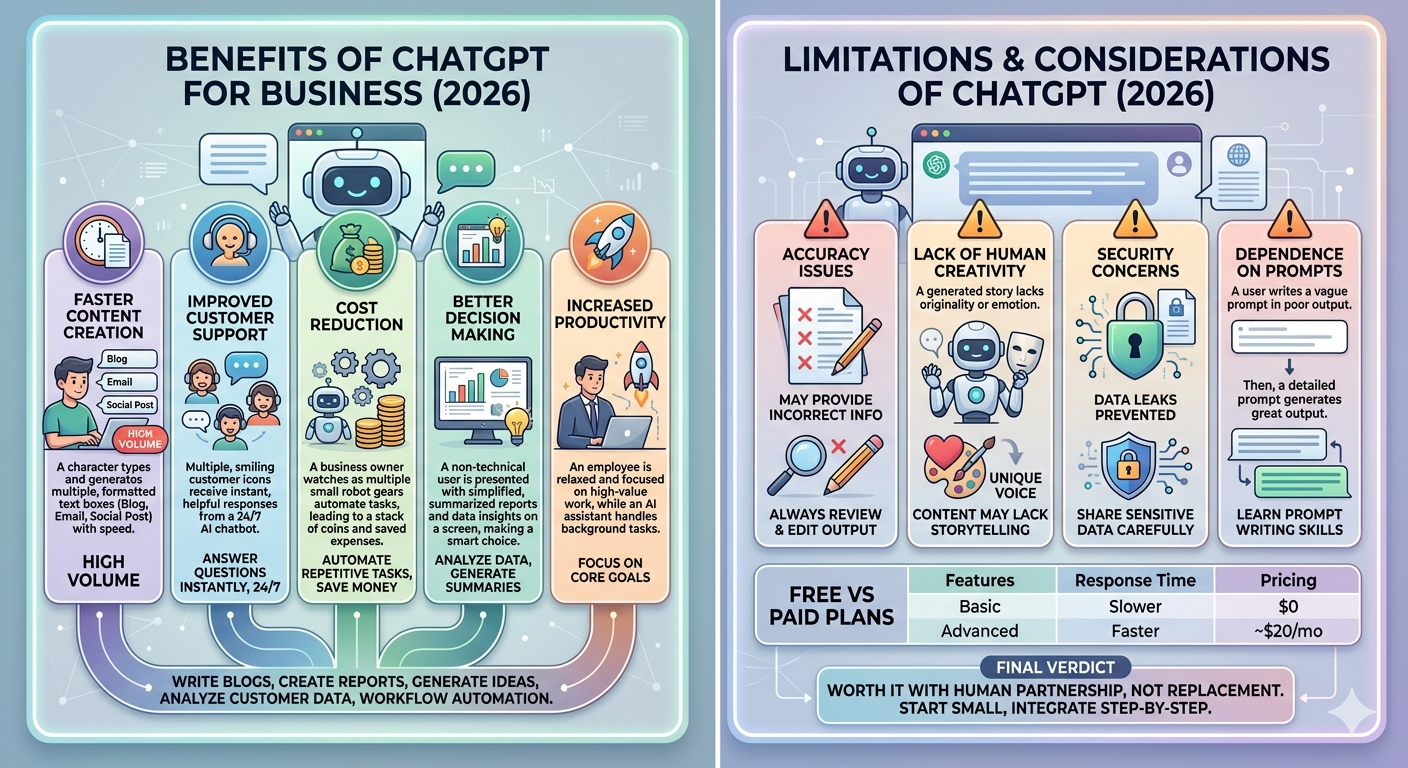
1. Faster content creation
ChatGPT can generate blog posts, emails, product descriptions, and social media content quickly. This helps businesses maintain consistency and publish content regularly.
It is especially useful for marketing teams that need high volume content.
2. Improved customer support
Businesses can use ChatGPT to answer common customer questions instantly. This reduces response time and improves customer satisfaction.
It can also be integrated into chatbots to provide 24/7 support.
3. Cost reduction
Hiring writers, support agents, and analysts can be expensive. ChatGPT reduces the need for large teams by automating many tasks.
This makes it a cost effective solution for startups and small businesses.
4. Better decision making
ChatGPT can analyze data, summarize reports, and provide insights. This helps business owners make smarter decisions based on information.
It is especially useful for non technical users who struggle with data analysis.
5. Increased productivity
By automating repetitive tasks, ChatGPT allows employees to focus on more important work.
Many businesses report significant productivity improvements after using AI tools.
Real use cases of ChatGPT in business
ChatGPT is not just theory. It is already being used in real business scenarios.
Common use cases include writing blogs and marketing content, generating reports, creating training materials, and analyzing customer data.
It is also used for internal documentation, idea generation, and workflow automation.
Limitations of ChatGPT
While ChatGPT is powerful, it is not perfect. Businesses should understand its limitations before relying on it.
1. Accuracy issues
ChatGPT can sometimes provide incorrect or outdated information. This means all outputs should be reviewed before use.
Experts recommend human oversight to avoid mistakes.
2. Lack of human creativity
Although ChatGPT can generate content, it may lack originality or emotional depth. Overuse can lead to generic content.
This is important for brands that rely on unique voice and storytelling.
3. Security concerns
Businesses must be careful when sharing sensitive data with AI tools. There is always a risk when handling private information.
Proper guidelines and policies should be in place.
4. Dependence on prompts
The quality of results depends heavily on how you use the tool. Poor prompts lead to poor output.
This means businesses need to learn prompt writing skills.
Free vs paid plans for businesses
ChatGPT offers both free and paid plans.
The free version is suitable for basic tasks and testing. However, it has limitations such as slower responses and fewer features.
Paid plans provide better performance, faster responses, and advanced tools. These are more suitable for businesses that rely heavily on AI.
Pricing usually starts around twenty dollars per month, making it affordable for most businesses.
When ChatGPT is worth it
ChatGPT is worth it for businesses if you:
Create content regularly
Handle customer queries
Want to automate repetitive tasks
Need help with research and data analysis
Are looking to save time and costs
It is especially valuable for startups, freelancers, and online businesses.
When ChatGPT may not be worth it
ChatGPT may not be ideal if you:
Need highly specialized or technical accuracy
Handle sensitive or confidential data
Expect fully automated workflows without human review
Do not have time to learn how to use it properly
In these cases, it should be used as a support tool rather than a complete solution.
Final verdict
So, is ChatGPT worth it for businesses?
The answer is yes, but with the right expectations.
ChatGPT is a powerful tool that can save time, reduce costs, and improve productivity. It is already being used by millions of businesses worldwide and continues to grow rapidly.
However, it is not a replacement for humans. It works best when combined with human skills, creativity, and decision making.
If you use it correctly, ChatGPT can become one of the most valuable tools in your business.
Conclusion
In 2026, businesses that use AI tools like ChatGPT have a clear advantage. They work faster, scale easier, and compete more effectively.
The key is not just using ChatGPT, but using it smartly.
Start small, test its capabilities, and integrate it into your workflow step by step. Over time, you will see how it can transform your business operations.
If you are serious about growth, ChatGPT is definitely worth trying.
Leave a Reply