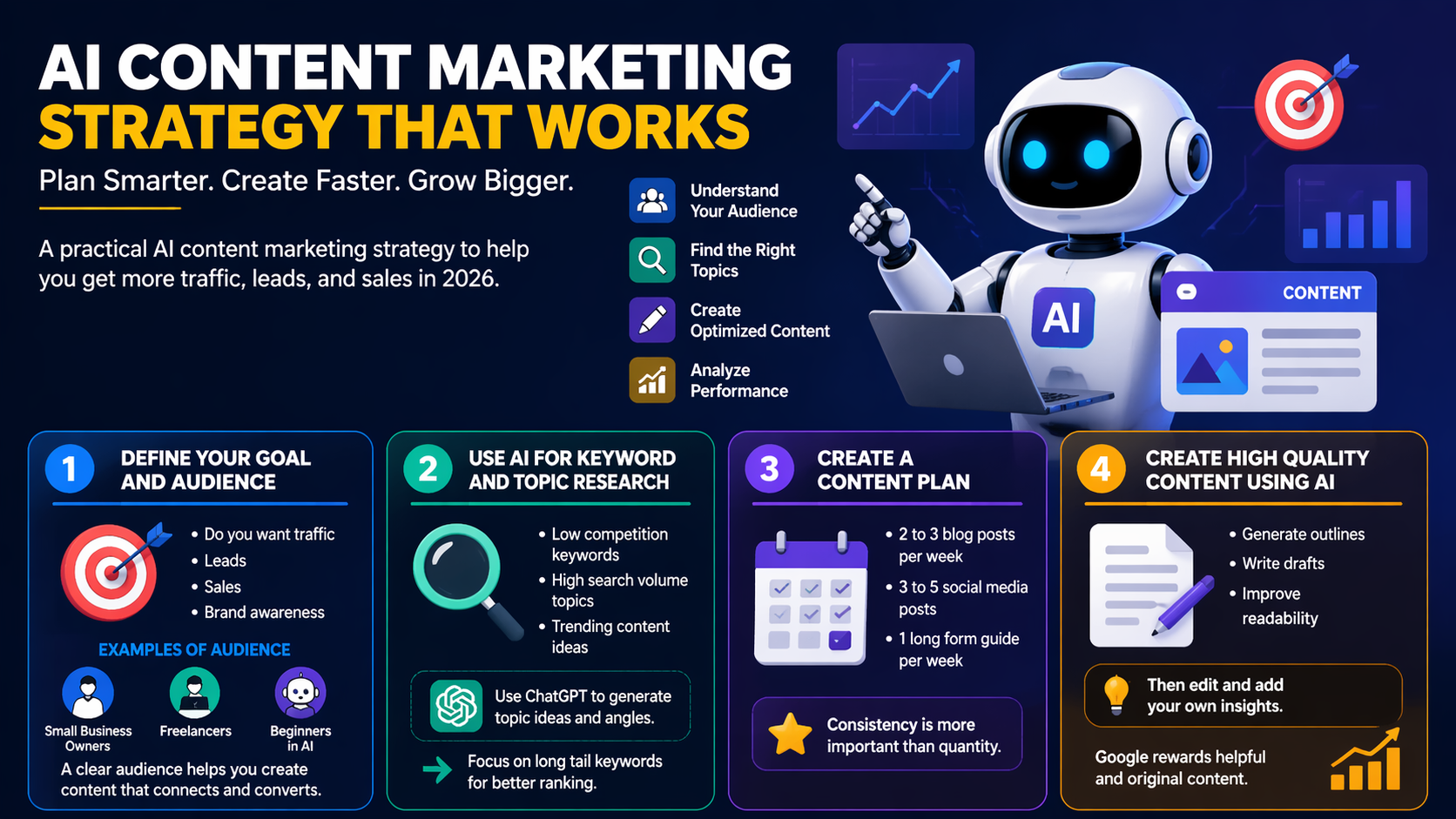
AI Content Marketing Strategy That Works
Content marketing is one of the most powerful ways to grow a business online. In 2026, artificial intelligence has completely changed how content is planned, created, and distributed. But using AI alone is not enough. You need a clear strategy that actually works.
Many people use AI tools but fail to get results because they focus only on content creation, not on strategy. In this guide, you will learn a practical AI content marketing strategy that helps you get traffic, leads, and sales.
Why AI is important for content marketing
AI allows you to create more content in less time, but its real power is in improving decision making.
It helps you:
Understand your audience
Find the right topics
Create optimized content
Analyze performance
This makes your marketing more effective and results driven.
Step 1: Define your goal and audience
Before creating any content, you must know your goal.
Ask yourself:
Do you want traffic
Leads
Sales
Brand awareness
Then define your audience.
For example:
Small business owners
Freelancers
Beginners in AI
A clear audience helps you create content that connects and converts.
Step 2: Use AI for keyword and topic research
Content starts with the right topics.
Use tools like Ubersuggest or Ahrefs to find:
Low competition keywords
High search volume topics
Trending content ideas
You can also use ChatGPT to generate topic ideas.
👉 Focus on long tail keywords for better ranking
Step 3: Create a content plan
Do not create random content.
Build a simple plan:
2 to 3 blog posts per week
3 to 5 social media posts
1 long form guide per week
Consistency is more important than quantity.
Step 4: Create high quality content using AI
AI can help you write content faster, but quality still matters.
Use AI to:
Generate outlines
Write drafts
Improve readability
Then edit and add your own insights.
👉 Google rewards helpful and original content
Step 5: Optimize content for SEO
Your content must be optimized to rank.
Focus on:
Keywords in titles and headings
Internal linking
Meta descriptions
Readability
Tools like Surfer SEO can help improve your content.
Step 6: Repurpose content across platforms
One piece of content can be used multiple times.
For example:
Turn a blog post into social media posts
Convert it into a video
Create email content
AI makes repurposing fast and easy.
👉 This increases reach without extra work
Step 7: Use AI for content distribution
Creating content is not enough. You must promote it.
Use AI tools to:
Schedule posts
Write captions
Optimize posting times
Share your content on:
Social media
Email newsletters
Communities
Step 8: Capture leads and monetize
Traffic alone is not enough. You need to convert it.
Use:
Email sign up forms
Lead magnets
Affiliate links
Digital products
Your content should guide users toward an action.
Step 9: Analyze and improve performance
AI can help you track results.
Monitor:
Traffic
Engagement
Conversions
Identify what works and improve what does not.
Step 10: Scale your content system
Once you see results, scale your strategy.
Publish more content
Target more keywords
Build topical authority
AI allows you to grow faster without increasing workload.
Simple content marketing funnel
Here is a simple system that works:
Top of funnel: Educational blog posts
Middle of funnel: Guides and comparisons
Bottom of funnel: Product recommendations
This moves users from awareness to purchase.
Common mistakes to avoid
Many people fail because they:
Focus only on AI writing
Ignore SEO
Do not have a strategy
Post inconsistently
Avoid these mistakes to get better results.
Final thoughts
AI content marketing is not about replacing humans. It is about improving efficiency and strategy.
The businesses that win are those that combine AI with smart planning.
Conclusion
An AI content marketing strategy that works is simple.
Choose the right topics, create valuable content, optimize for SEO, and distribute consistently.
Use AI as a tool, not a shortcut.
If you follow this system, you can grow your traffic, build authority, and increase your income in 2026 and beyond.
Leave a Reply